

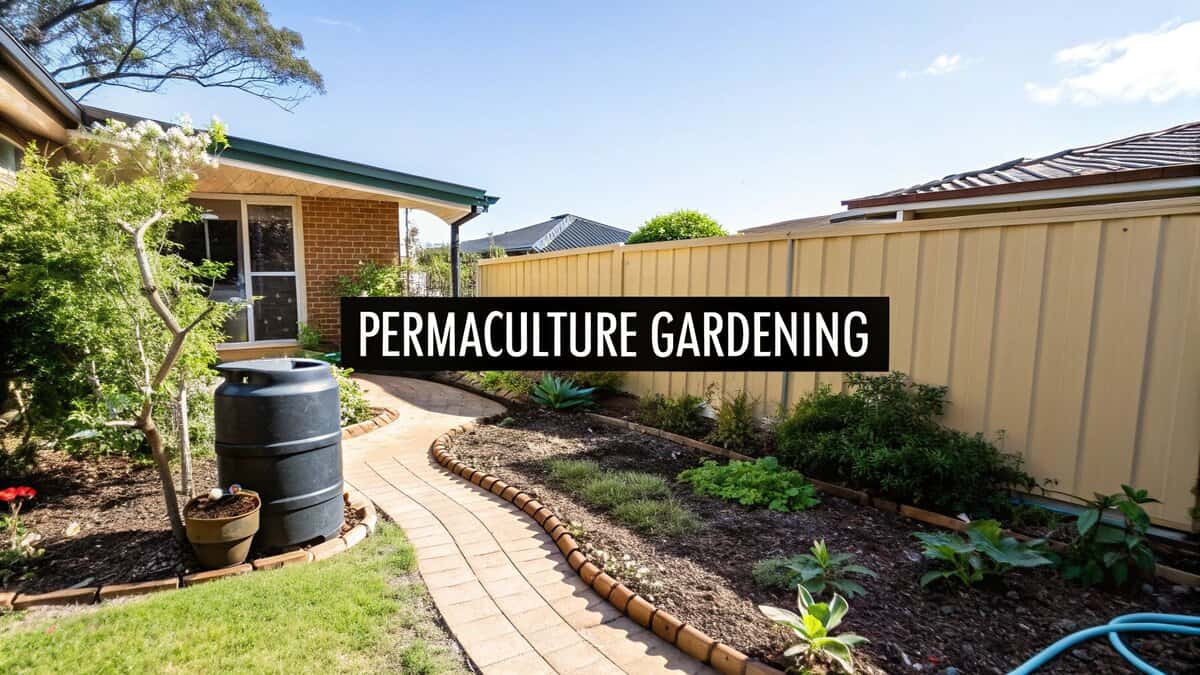
So, what is permaculture gardening? Essentially, it is a design philosophy, it is a design philosophy that copies the clever systems found in nature. This creates a garden that pretty much runs itself. Ultimately, it’s all about working with nature, not fighting against it. This approach builds a garden that is productive, beautiful, and surprisingly low-maintenance.
For quotes and bookings, call or email us here.
The Basics of What is Permaculture Gardening
Permaculture isn’t just a set of gardening techniques; it’s a whole new way of looking at your garden. Instead of neat rows of plants that demand constant attention, you start to see a web of connections. In a permaculture garden, every single element—from the worms in the soil to the tallest fruit tree—is there to support something else.
This idea got its start back in the 1970s with two Australians, Bill Mollison and David Holmgren. Consequently, they wanted to create a sustainable way of living by blending ecology with smart landscape design. Today, permaculture gardens are all about using perennial plants, capturing rainwater, and creating harmonious systems. In these systems, trees, shrubs, and vegetables all grow together.
The Core Components
So, what holds this whole concept together? In short, it is guided by a simple set of ethics and principles. These are not strict rules, just common-sense guidelines for making good decisions in the garden.
The ultimate aim is to create what’s called a ‘closed-loop system’. This just means that you see waste as a resource. For example, your kitchen scraps do not go in the bin; they become compost that feeds your soil. This approach builds a really resilient garden that can handle the unpredictable Stoke-on-Trent weather much better than a conventional one.
Let’s quickly look at how this approach stacks up against traditional gardening methods.
Permaculture vs. Conventional Gardening: A Quick Look
| Aspect | Permaculture Gardening | Conventional Gardening |
|---|---|---|
| Goal | Create a self-sustaining ecosystem | Maximise yield of specific plants |
| Labour | Intensive at the start, then low-maintenance | Consistent high labour (weeding, tilling) |
| Soil Health | Builds soil with compost and mulch (“no-dig”) | Often relies on tilling and chemical fertilisers |
| Diversity | High (polyculture – many plants together) | Low (monoculture – single crops in rows) |
| Waste | Waste is a resource (e.g., composting) | Waste is often removed (e.g., clippings) |
| Water | Captures and stores rainwater (e.g., swales) | Relies on regular irrigation |
This table shows a fundamental shift in thinking. Specifically, permaculture is about building a lasting, living system, not just growing plants for a single season.
A Fresh Mindset for Your Garden
Here at Stoke Gardening Services, we help local homeowners get into this way of thinking. It all starts with observation and thoughtful planning. This ensures your garden is as practical as it is beautiful. Of course, any great garden begins with the soil. If you’re looking to get the foundation right, you might find our guide on how to prepare soil for planting really useful.
The core idea behind permaculture is to create a system that produces more energy than it consumes. Over time, your garden should give you more back in food, beauty, and enjoyment than the effort you put into it.
This changes your relationship with your garden. Instead of a constant chore, it becomes a collaboration. You are not just a gardener; you are the designer of a living system that works for you. Ultimately, it provides healthy food and a beautiful sanctuary right in your own backyard.
The Three Simple Rules of Permaculture Gardening
Permaculture is not about following a rigid set of instructions. In reality, it is a way of thinking, guided by three core ethics. These act like a compass for every decision you make in your garden. Think of them as the heart and soul of permaculture. Consequently, they make sure your patch is productive, responsible, and a joy to be in.
This ethical framework is what helps us build gardens that truly last. It connects what we do in our own backyard to the bigger picture. By taking these ideas on board, anyone in Stoke-on-Trent can create a garden that genuinely gives back.
Care for the Earth
First up, and most importantly, is Care for the Earth. This is all about actively working to make our corner of the planet healthier. It starts with the very soil under our feet. Instead of taking from the soil season after season, the goal is to build it up and make it better.
In practice, this means creating rich, living soil by composting and mulching. Moreover, it’s about being smart with water and creating little pockets of habitat for local wildlife. Your garden can become a small but thriving ecosystem that boosts biodiversity right here in Stoke-on-Trent.
Care for People
Next comes Care for People. This principle is about making sure our gardens meet our own needs and those of our community. Importantly, this happens without causing harm. It’s about so much more than just putting food on the table; it’s about nurturing ourselves and those around us.
This might look like growing nutritious, chemical-free food for your family to enjoy. Also, it means creating a beautiful, peaceful space where you can relax and connect with nature. Indeed, a well-designed garden can be a real sanctuary, improving both your physical and mental health.
At its core, ‘Care for People’ is about ensuring that everyone has access to the resources they need to live a healthy, comfortable, and fulfilling life. Your garden can be a powerful tool for achieving this on a personal scale.
This ethic pushes us to design gardens that are accessible and genuinely good for everyone who uses them.
Fair Share
Finally, the third ethic is Fair Share, which is sometimes called ‘Return of Surplus’. This is the simple idea of taking only what you need and sharing the rest. Essentially, it’s about understanding that resources are finite. This ensures nothing goes to waste.
This is where clever resource management comes into play. For instance, when you compost your kitchen scraps, you turn “waste” into “black gold” for your soil. Got a massive crop of tomatoes you cannot possibly eat? Sharing them with a neighbour is Fair Share in action.
Here’s a simple look at how these ethics weave together:
- Earth Care: You create fantastic, healthy soil using your own homemade compost.
- People Care: That healthy soil grows delicious, nutrient-packed veg for your family.
- Fair Share: Any extra compost or vegetables get shared, so no resource is wasted.
Ultimately, these three ethics are completely intertwined. When you care for the earth, you automatically care for people. By making sure there’s a fair share for everyone, you create a balanced system. Here at Stoke Gardening Services, we build these principles into every design. We create gardens that are not just productive and beautiful, but deeply ethical too.
What Are the Real Benefits of a Permaculture Garden?

Once you understand the ‘why’ behind what is permaculture gardening, its true value really clicks. This is so much more than just a set of gardening techniques. It is an approach that brings real, tangible rewards to your garden, your lifestyle, and our local environment here in Stoke. Basically, it’s all about creating a space that works smarter, not harder.
The most profound benefit starts right under your feet—with healthier soil. Instead of constantly taking from the earth, permaculture methods actively build rich, living soil. This is the secret to stronger plants, fewer pests, and a resilient garden.
Creating a Thriving Ecosystem in Stoke-on-Trent
Walk into a permaculture garden, and you will notice it’s buzzing with life. By choosing a diverse mix of plants, you roll out the welcome mat for beneficial insects. In addition, you create different habitats for birds and pollinators. Before you know it, you have a built-in, natural pest control team working for you.
This boost in biodiversity makes your garden incredibly resilient. It is not just a feeling; the science backs it up. A recent study found permaculture sites had a staggering 457% higher richness of vascular plants. They also had 197% more bird species compared to conventional fields. Those numbers really show how powerful this approach is.
On top of that, this method is brilliant for saving water. Simple techniques like mulching and contouring help capture rainwater. They store it right where it’s needed—in the soil. That means less time spent with the hose and a garden that’s better prepared for dry spells.
“The core advantage of a permaculture system is its resilience. As it matures, it requires less input from you while providing greater output in food, beauty, and biodiversity.”
For homeowners in Stoke-on-Trent, this translates to a garden that becomes less work. Consequently, it is cheaper to run over time. You will find yourself buying fewer fertilisers and pesticides. You may even notice a drop in your water bill. What you get in return is a beautiful garden that practically takes care of itself.
Building Healthier Soil and a Healthier Planet
Healthy soil is the bedrock of any great garden. Every technique in permaculture improves soil life and structure. For instance, research shows that earthworm numbers were 201% higher in permaculture systems. Earthworms are a classic sign of healthy soil.
Better yet, that healthy soil is also a champion for the climate. The very same study discovered that permaculture sites stored 27% more carbon in the soil. This helps pull it out of the atmosphere. You can read more about these amazing results and how permaculture improves soil health on nature.com.
For you, this all means better results with far less effort. Here at Stoke Gardening Services, our team can design a garden that brings all these benefits to your doorstep. We are here to help you create a beautiful, productive, and self-sustaining sanctuary in your own backyard.
Starting Your Permaculture Gardening Journey

Putting theory into practice is the best part of learning what is permaculture gardening. You do not need a massive garden or decades of experience to get going. In fact, anyone in Stoke-on-Trent can start applying these powerful techniques. You can build a healthier, more productive garden right now.
These methods are all about working smarter, not harder. They mimic patterns found in nature. Thus, they help you create a garden that starts to look after itself. Let’s walk through a few simple but effective techniques you can try.
Build Incredible Soil with Lasagna Gardening
A fantastic starting point is a method called ‘lasagna gardening’. Instead of all that back-breaking digging, you build your soil upwards in layers. This no-dig approach is a game-changer for improving Stoke’s often heavy clay soil.
It’s surprisingly simple. You lay organic materials directly on top of your lawn or an old garden bed. First, start with a layer of cardboard to smother any weeds. Then, pile on alternating ‘green’ layers and ‘brown’ layers. Over a few months, these layers break down into beautifully rich, fertile soil.
This technique does not just save you a ton of work. It also creates the perfect home for earthworms and beneficial microbes. In fact, these tiny helpers do the heavy lifting of building healthy soil for you.
A core permaculture idea is that the problem is the solution. That patch of weeds you’ve been fighting? It’s not a problem—it’s the perfect foundation for a new, no-dig garden bed that will feed your family for years.
Create Powerful Plant Teams with Guilds
Another key concept in understanding what is permaculture gardening is the ‘plant guild’. Think of a guild as a little team of plants. They work together to help each other thrive. Instead of planting a single crop in neat rows, you group plants that have a mutually beneficial relationship.
A classic example is the ‘Three Sisters’ guild. This guild combines corn, beans, and squash:
- The corn provides a natural trellis for the beans to climb.
- The beans pull nitrogen from the air and add it to the soil, feeding the other two plants.
- The squash spreads its large leaves across the ground, acting as a living mulch.
It’s a brilliant way to boost your garden’s output. Simultaneously, you can naturally keep pests at bay and improve your soil. This is an easy win for any Stoke-on-Trent garden, no matter its size.
Harvest Rainwater for a Resilient Garden
Water is a precious resource. Therefore, even a simple rainwater harvesting system can make a huge difference. You do not need a complicated, expensive setup. Just placing a water butt under a downspout is a fantastic first step.
The rainwater you collect is actually better for your plants than treated tap water. It also makes you less reliant on the mains supply. As a result, this saves you money and helps your garden push through those inevitable dry spells.
Building your own systems is incredibly rewarding. Additionally, great compost is key to helping your soil hold onto that precious water. You can find some great ideas in our guide to DIY compost bin designs, which is a perfect project for closing the loop in your own garden.
Bringing Permaculture to Your Stoke-on-Trent Garden
It’s one thing to read about permaculture gardening. However, it’s another thing entirely to see it come to life in your own backyard. That is where the real magic happens.
Here in Stoke-on-Trent, every garden has its own unique potential. We can help you build a beautiful, productive little ecosystem. We will create a perfect fit for our local climate.
It all starts with a friendly chat and a look at your site. First, we listen to what you want. Then, we get to work designing a system that works with your specific landscape.
Turning Local Challenges into Opportunities
Every garden has its quirks. In Stoke-on-Trent, many of us deal with heavy clay soil or tight urban spaces. But instead of seeing these as roadblocks, we treat them as starting points for smart design.
We can turn these challenges into real assets. For instance, we use no-dig methods and select specific plants. These plants break up dense clay, transforming it into rich, fertile ground over time. For smaller gardens, we think vertically. We use clever layering and plant guilds to get the most out of every single square inch.
By simply observing and working with the natural patterns of your own patch of land, we can create a garden that doesn’t just survive—it thrives. This is the heart of great local permaculture design.
Your Local Permaculture Experts for Stoke-on-Trent
Our team has a deep-rooted understanding of Staffordshire’s climate and soil. This means we can build gardens that are truly resilient. Eventually, they need a lot less work from you.
We know which fruit trees will do well here. Also, we know the best spots to catch the sun and how to protect your plants. Indeed, it’s this local knowledge that makes all the difference.
We can handle the entire process. This runs from the first sketch to the full installation of your dream garden. If you love growing your own food, our designs can make your plot incredibly productive. You can find more tips on this in our guide to vegetable gardening.
Ready to create a beautiful, low-maintenance haven? Contact Stoke Gardening Services today. Let’s start planning your garden’s transformation.
Got Questions About Permaculture Gardening?
Diving into something new like permaculture always brings up a few questions. That is completely normal. So, let’s walk through some of the most common ones we hear from folks right here in Stoke-on-Trent. Getting these sorted will help you feel much more comfortable getting started.
Think of this as a quick chat over the garden fence. We offer simple, practical answers to help you see what this is all about.
Do I Need a Big Garden for What is Permaculture Gardening?
Absolutely not. In fact, that is one of the biggest myths out there. Permaculture is all about smart thinking, not square footage. The principles work just as beautifully on a small Stoke-on-Trent patio as they do on a massive plot.
We get creative with techniques like vertical gardening and clever plant stacking. Ultimately, it is all about creating a mini-ecosystem in whatever space you have. You learn to make every inch count.
Permaculture isn’t defined by the scale of the garden but by the depth of thought behind its design. A well-planned container garden can be a more functional ecosystem than a poorly designed acre.
Is Permaculture More Expensive Than Regular Gardening?
There can be a bit of an upfront investment. This is especially true if you are setting up water collection systems or buying specific perennial plants. But the whole point of permaculture is to create long-term savings. In short, you will drastically cut down on buying fertilisers, pesticides, and even compost.
Over time, your water bills will drop, too. By designing a garden that uses its own resources, we aim to lower your costs. The garden truly starts to pay for itself.
How Is What Is Permaculture Gardening Different From Organic?
That is a fantastic question. Indeed, it gets to the heart of what makes permaculture special. They are related, but they are not the same thing.
- Organic gardening is mainly a set of rules about what you can’t use. It’s about being clean.
- Permaculture gardening takes that idea and builds a whole world around it. It is a complete design philosophy.
Instead of just avoiding the bad stuff, permaculture focuses on actively creating a self-sufficient ecosystem. Here, every plant and drop of water has a job to do. As a result, the garden is not just organic, but also resilient, productive, and a lot less work.
How Long Does It Take to Get a Garden Going?
You will start seeing benefits right away. For example, things like better soil and more wildlife activity can happen from day one. But for the garden to become a fully mature, self-regulating system—that takes a bit of time. It usually takes a few years.
The brilliant trade-off is that the more mature the garden gets, the less you have to do. It slowly starts to take care of itself. In essence, it’s an investment of patience that pays you back with a thriving, beautiful, and low-maintenance garden.
What Services Do You Offer?
Ready to see how these principles can transform your own outdoor space? Stoke Gardening Services is here to help you create a beautiful, productive, and sustainable garden right here in Stoke-on-Trent.
For quotes and bookings, call or email us here.
Responses
[…] see how these ideas connect to a larger philosophy, you might be interested in our guide on what is permaculture gardening. By learning from the past, we can create more vibrant, resilient, and productive gardens for the […]
[…] This strategy is a cornerstone of sustainable gardening. For those in Stoke-on-Trent looking to create a resilient, low-maintenance garden, embracing biological control is a crucial first step. It is a key principle in creating a thriving ecosystem, a concept further explored in permaculture gardening. […]
[…] place. This concept aligns well with the sustainable principles found in permaculture. You can learn more about creating a self-sustaining garden to enhance your edible […]
[…] Building the Layers: Start the bed with a base layer of cardboard to suppress weeds. Then, add layers of carbon-rich materials like twigs and straw, followed by nitrogen-rich materials like grass clippings and manure. Top it off with a good quality compost and topsoil mix. This technique is a core principle of permaculture, which you can explore in more detail here. […]
[…] Some families embrace sustainable practices around their living memorial, like those found in permaculture gardening principles. This approach helps create a self-sustaining environment that honors nature even more deeply. This […]
[…] Some families embrace sustainable practices around their living memorial, like those found in permaculture gardening principles. This approach helps create a self-sustaining environment that honors nature even more deeply. This […]