

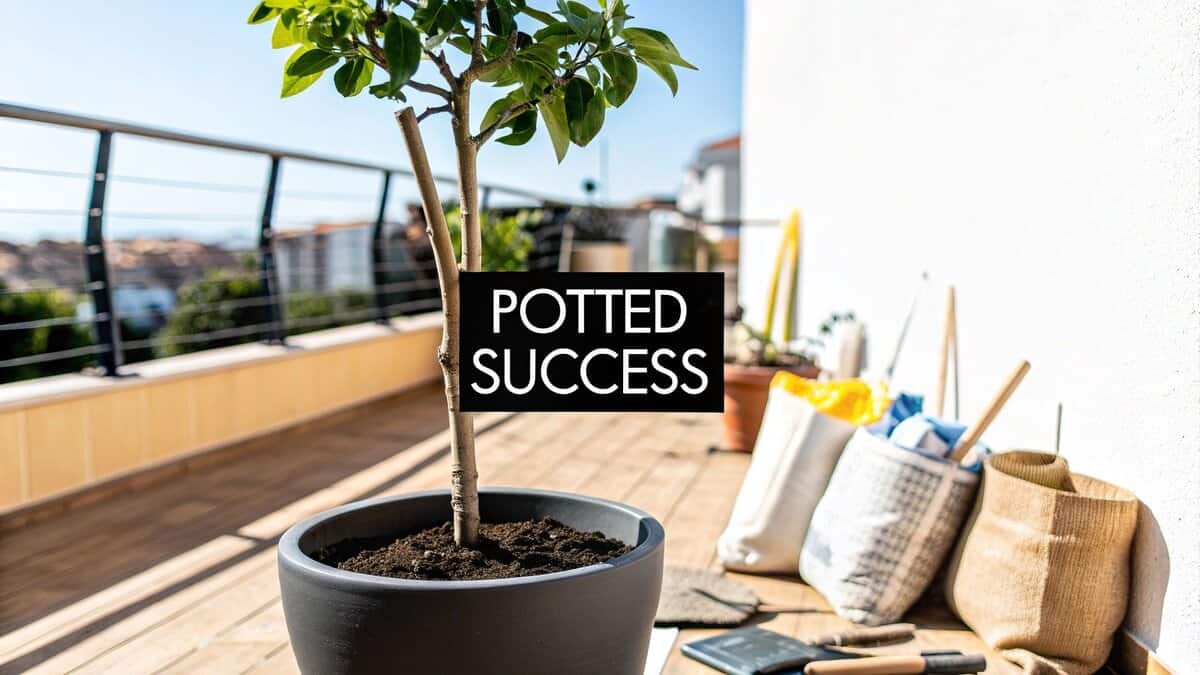
Having your own fruit tree, even in a small space, is one of the real joys of gardening. Indeed, the secret lies in a few key choices. You should pick a dwarf variety, get a big enough pot with great drainage, and mix up a soil that’s packed with nutrients. Consequently, if you get these right, you’ll have a healthy, fruit-producing tree right on your patio or balcony.
For quotes and bookings, call or email us here.
Why Potting Fruit Trees Is a Brilliant Idea
Growing fruit in containers isn’t just a passing trend; in fact, it’s a smart, practical solution for the way many of us live and garden today. For gardeners here in Stoke-on-Trent, it offers some really specific advantages. For instance, the most obvious one is how little space it takes. You don’t need an orchard to enjoy fresh apples or cherries—a sunny corner on a patio will do just fine.
What’s more, container gardening gives you an incredible amount of control. For example, you can wheel your tree into a sheltered spot to protect it from a sudden frost. You can also shift it around to catch the best of the day’s sun. This kind of flexibility is a massive bonus, especially with our notoriously unpredictable Stoke-on-Trent weather.
The Big Wins of Planting Fruit Trees in Pots
This approach comes with a few powerful perks for any gardener:
- Easier Pest and Disease Control: When your tree is up in a pot, it’s a lot harder for common garden pests to crawl their way up. Furthermore, it also makes it much easier to spot problems like aphids or black spot early on, before they get out of hand.
- Perfect Soil, Every Time: You get to be the master of your soil mix. As a result, this means you can create the ideal blend from day one. You can give your tree exactly the nutrients and drainage it needs to thrive—something that’s much trickier to manage in garden soil.
- Your Tree Can Move With You: If you ever move house, your prized fruit tree can come along. Consequently, this is a huge plus, both emotionally and practically. It is especially true for renters or anyone who might not be in their “forever garden” just yet.
This isn’t just something we’re seeing locally. In fact, the boom in container fruit trees has grown alongside urbanization across the globe. Industry data shows that over 100,000 potted fruit trees are now sold every year worldwide. Clearly, there’s a huge appetite for fresh, homegrown fruit in our cities and towns. You can learn more about the global rise of sustainable container gardening to see the bigger picture.
At the end of the day, planting a fruit tree in a pot lets you grow your own amazing produce just about anywhere. However, it does take a bit of know-how to get it right. If you’re in the Stoke-on-Trent area and want to give your tree the best possible start, our expert team is here to help. Indeed, we offer professional planting services that cover everything from picking the right tree to creating the perfect soil mix.
Your Guide to Planting a Fruit Tree in a Pot
Getting your potted fruit tree off to a flying start really comes down to two key decisions. These are the tree itself and the container you put it in. If you nail these two things from the get-go, then you’re well on your way to a successful harvest.
First, Find the Right Tree
Here in Stoke-on-Trent, we need to be practical about our climate. Therefore, that means looking for tough, self-pollinating varieties that won’t mind a bit of a chill. For instance, think apples like ‘Discovery’ or pears like ‘Concorde’—they’re brilliant choices.
But the most important detail, and one you can’t skip, is the rootstock. You absolutely must choose a tree grown on a dwarf or semi-dwarf rootstock. These have been specifically developed to stay small and manageable. Consequently, they are perfect for life in a pot.
Next, Choose the Perfect Pot
With your tree sorted, it’s time to think about its home. The size of the container will make or break your tree’s health and its ability to give you fruit. In fact, a pot that’s too small will cramp the roots and stunt the tree’s growth before it even has a chance.
You’ll want to start with a container that’s at least 45-60cm (18-24 inches) across. This gives the roots plenty of room to spread out and establish a strong foundation. In fact, research shows that a pot volume between 15 and 30 gallons is what you need for a happy, productive tree in the long run. If you’re curious about the science, you can dive into the research on fruit tree spacing and soil volume for a deeper understanding.
The material of the pot makes a big difference, too. Classic terracotta looks fantastic, but it’s porous and dries out very quickly on a warm summer day. On the flip side, plastic or glazed ceramic pots do a much better job of holding onto moisture.
Whatever you choose, there’s one feature that is an absolute deal-breaker: excellent drainage. Your container must have plenty of holes at the bottom. Without them, water just sits there, and you’ll end up with root rot—a death sentence for most potted trees.
If you’re in the Stoke-on-Trent area and want a hand, our team at Stoke Gardening Services can help. We can source the perfect dwarf fruit tree and a high-quality container to set you up for success.
Comparing Container Materials for Fruit Trees
Choosing a pot material can feel overwhelming. However, it really just depends on your budget, style, and how often you plan to water. So, here’s a quick breakdown to help you decide.
| Material | Pros | Cons | Best For |
|---|---|---|---|
| Terracotta | Classic look, porous so roots can breathe. | Dries out fast, heavy, can crack in a hard frost. | Gardeners who don’t mind watering frequently and love a traditional aesthetic. |
| Plastic | Lightweight, great at retaining moisture, affordable. | Can get brittle with age, less breathable for roots. | Anyone looking for a practical, low-maintenance, and budget-friendly option. |
| Glazed Ceramic | Beautiful designs, holds moisture well. | Very heavy, can be expensive and fragile if knocked. | Creating a stunning garden feature where the pot is as important as the plant. |
| Wood | Provides great insulation for roots against heat and cold. | Can eventually rot if not properly treated or lined. | Achieving a natural, rustic look that blends into the garden. |
Ultimately, the best pot is one that has good drainage. It must give your tree’s roots enough space to grow. Therefore, don’t be afraid to start with a good-sized plastic pot. You can then upgrade to a more decorative one later on once the tree is established.
Creating the Perfect Potting Mix for Planting a Fruit Tree in a Pot

Alright, you’ve got your tree and the perfect pot. Now for the most important part: what you’re going to fill that pot with. Indeed, it’s so tempting to just grab a shovel and use soil from your garden. However, trust me, that’s a recipe for disaster.
Garden soil in a pot becomes a solid, compacted brick over time. Furthermore, it suffocates the roots and turns into a swamp every time you water. To give your tree a fighting chance, you need to create a potting mix. It should provide structure, nutrients, and, most importantly, drainage.
Building Your Soil Foundation
The best place to start is with a high-quality, soil-based compost. Indeed, I always recommend a loam-based mix like John Innes No. 3 for potting fruit trees. It has enough weight to keep the tree stable as it grows. It also comes packed with the nutrients a young tree needs to get established.
But even a great mix like John Innes can be made better. In fact, a few simple additions will elevate it from good to great. They will tackle the most common issues before they even start.
If there’s one thing that kills potted trees, it’s waterlogged soil. Good drainage isn’t just a nice-to-have; in fact, it’s absolutely crucial for keeping the roots healthy and preventing rot.
Key Additives for a Superior Mix
To really nail this, you want to think about drainage and long-term nutrition. So, these are my go-to amendments that make all the difference.
- Improve Drainage: Mix in horticultural grit or perlite to make up about 20% of your final mix. As a result, this creates little air pockets throughout the soil. This is vital for letting excess water escape freely.
- Add Long-Term Nutrients: Before you start filling the pot, toss in a handful of slow-release fertiliser granules. Thus, this acts like a packed lunch for your tree. It feeds it steadily for the first few months while it settles in.
- Boost Organic Matter: While John Innes is a fantastic base, mixing in some of your own well-rotted organic matter will work wonders. If you’re into home composting, then this is the perfect place to use it. You can learn about the different methods of composting to create your own powerhouse amendments.
If sourcing all these bits and pieces feels like a bit much, don’t worry. Our team at Stoke Gardening Services is here to help. We offer professional planting services right here in Stoke-on-Trent. Furthermore, we use our own tried-and-tested potting mix to give every tree the best possible start.
How to Plant Your Fruit Tree in a Pot
Alright, you’ve got your pot, you’ve mixed your soil—now for the fun part. This is where all that prep work pays off as you give your new tree its home. Indeed, a little care and attention at this stage will make all the difference. This will help your tree settle in quickly and set it up for years of healthy growth.
First things first, let’s get that pot ready. I like to place a few crocks or some large stones over the drainage holes. It’s a simple trick that stops your carefully mixed soil from washing straight out. Yet it still lets excess water escape.
Now, add a good layer of your potting mix to the bottom of the container. You’re aiming for a depth that puts the top of your tree’s root ball a couple of inches below the pot’s rim. Think of it as creating a solid foundation.
Placing and Planting Your Tree
Time to introduce the tree to its new home. First, gently ease it out of the nursery pot it came in. Then, take a look at the roots. If they’re a tangled, circling mess, don’t be shy about gently teasing them apart with your fingers. Consequently, this encourages them to grow outwards into all that lovely new soil.
Next, centre the tree in the pot. And here’s a detail you absolutely cannot get wrong. It affects the tree’s health for its entire life. Look for the graft union—it’s that knobbly, swollen-looking area near the base of the trunk. This is where the fruiting part of the tree was grafted onto the rootstock.
You must keep the graft union well above the final soil level. If you bury it, the top part of the tree can send out its own roots. This completely bypasses the dwarfing effect of the rootstock. As a result, you get a much larger tree than you bargained for.
Holding the tree steady, start backfilling around it with your soil mix. As you go, gently firm the soil down with your hands. This gets rid of any big air pockets lurking around the roots. Just don’t compact it into a brick! If you want a quick refresher on getting that soil mix just right, we have a detailed guide on how to prepare soil for planting.
This image breaks down the key elements to get right from the start.

As you can see, getting the pot size, soil, and initial watering right are the three pillars for success.
Once the pot is full, give your newly planted tree a really good drink. So, water it slowly until you see a steady stream coming out of the drainage holes. This first watering is vital. For instance, it helps settle the soil around the roots. It also gives the whole system a deep hydration boost to recover from the shock of being moved. In conclusion, it’s the final welcome to its new home.
Keeping Your Potted Fruit Tree Happy for the Long Haul

Getting your fruit tree settled into its new pot is a great first step. However, the real journey is just beginning. To get that tree to thrive for years and give you basket after basket of fruit, you need a solid care routine. Indeed, it’s a bit different than caring for a tree in the ground. Your potted tree depends on you for everything.
Don’t let that intimidate you, though. In fact, a little consistent attention is all it takes to keep your tree healthy and productive. Once you get into a rhythm, it becomes a simple and rewarding part of your gardening life.
The Essentials: Watering and Feeding
Watering is, without a doubt, the most important job on your list. Pots dry out much faster than garden soil. This is especially true on a sunny patio during a warm Stoke-on-Trent summer. So, on hot days, you’ll likely need to water daily.
The easiest way to check is the old-fashioned finger test. First, stick your finger about an inch into the soil. If it feels dry, then it’s time to give the tree a good, deep drink.
Feeding is the other side of the coin. The nutrients in the pot’s soil get used up over time. Therefore, you have to replenish them. A simple feeding schedule works wonders:
- Spring & Summer: This is the growing season. So, give your tree a balanced liquid fertilizer every couple of weeks. A standard tomato feed is actually perfect for the job.
- Autumn & Winter: When the tree goes dormant, stop feeding. Then, let it rest.
This routine gives your tree the steady supply of fuel it needs. Consequently, it can grow strong and produce that delicious fruit you’re waiting for.
Shaping Up: Pruning and Repotting
Pruning isn’t just about making the tree look tidy. In fact, it’s crucial for its health and how much fruit it will produce. You’re aiming for an open, goblet-like shape. Consequently, this lets sunlight and air get to the center of the tree. This helps ripen the fruit and keeps fungal diseases at bay.
A quick tip from experience: The best time to prune most apple and pear trees is in winter when they’re dormant. But for stone fruits like plums and cherries, wait until summer. Pruning them in winter can leave them vulnerable to a nasty fungal infection called silver leaf disease.
After a while, your tree is going to get a little too big for its pot. Repotting every two to three years is the key to its long-term health. Indeed, it’s a straightforward job that gives the roots fresh soil and more room to grow.
Just move it to a pot that’s a few inches wider in diameter. Thus, this keeps it from becoming root-bound and ensures it has everything it needs to keep thriving. If tasks like pruning feel a bit out of your comfort zone, our Stoke-on-Trent team at Stoke Gardening Services is always here to lend a hand with expert care.
It’s also nice to remember that your little tree is doing more than just providing snacks. In its own small way, it’s part of urban greening. For example, it captures CO2 right on your patio. If you’re curious, you can discover more about how tree planting contributes to carbon capture and appreciate the bigger impact of your small garden.
Need a Hand? Stoke-on-Trent’s Planting Service is Here to Help
Feeling a bit out of your depth? Indeed, it’s completely understandable. While growing your own fruit is one of the most rewarding things you can do, getting a potted tree started correctly takes a bit of know-how.
Unfortunately, simple mistakes made at the planting stage can cause headaches later on. That’s exactly why we offer our local planting service right here in Stoke-on-Trent.
Think of it as a hassle-free head start. Our experienced Stoke-on-Trent team can take care of absolutely everything. Thus, we ensure your tree gets the perfect foundation for a long, fruitful life.
We Plant for Perfect Results
First, we’ll source the perfect dwarf tree—one that’s known to do well in our unique Stoke-on-Trent climate. Then, we use our own specially formulated potting mix that we’ve perfected over the years. This gives roots the ideal blend of nutrients, aeration, and drainage.
We handle the planting from start to finish. In conclusion, we make sure every detail is just right.
Our main goal is to help you sidestep the common pitfalls. For instance, we see people burying the delicate graft union. We also see them using heavy garden soil that turns to concrete in a pot. A proper start is the single best thing you can do for your new fruit tree.
Our service covers all the bases:
- Sourcing the right tree for your garden and our local weather.
- Providing a high-quality pot with fantastic drainage.
- Using a professional-grade potting mix to promote healthy roots.
- Ensuring the perfect planting depth to protect the vital graft union.
Let us do the heavy lifting. So, all you have to do is sit back and look forward to a beautiful, thriving tree. And, of course, that delicious first harvest.
If you’re searching for a reliable and skilled gardener near me in Stoke-on-Trent, we’d be delighted to help with all your gardening projects.
Give Stoke Gardening Services a call today for a friendly, no-obligation chat, and let’s get your container orchard growing.
Got Questions About Your Potted Fruit Tree? We’ve Got Answers
Even with the best plans, a few questions are bound to come up when you’re planting a fruit tree in a pot. Let’s tackle some of the most common ones we hear from fellow gardeners right here in Stoke-on-Trent.
What are the best fruit trees for pots in the UK?
This is always the first thing people ask. For our UK climate, you’ll have the best luck with hardy apple, pear, cherry, and plum trees. This is especially true for those grown on dwarf rootstock.
I always recommend looking for self-fertile varieties. For example, think ‘Discovery’ apples or ‘Stella’ cherries. They’re brilliant choices because they handle our weather well and you won’t need a second tree to get fruit.
How often should I repot my tree?
This is a big one. As a rule of thumb, you should plan on repotting your fruit tree every two to three years. Indeed, this isn’t just about giving it a bigger home. It’s crucial for refreshing the soil with new nutrients and letting the roots stretch out.
Help! My Tree’s Leaves Are Turning Yellow
Seeing yellow leaves can be alarming, but don’t panic. In fact, it’s usually a sign that something’s off with the watering schedule. It could be too much water, which leads to root rot. Alternatively, it could be too little, which puts the tree under stress.
Yellow leaves can also point to a nutrient deficiency, usually nitrogen. Before you do anything, stick your finger in the soil to check the moisture. If the soil is damp, then hold off on watering. Then, consider if it’s time to feed your tree with a balanced fertilizer.
At the end of the day, success with planting a fruit tree in a pot comes down to paying attention. Catching these little signs early means you can fix them before they become big problems. As a result, you will keep your tree happy and fruitful for years to come.
Ready to get started but want a professional to handle the heavy lifting? The team at Stoke Gardening Services offers expert planting services right here in Stoke-on-Trent, making sure your new tree gets the best possible start.
For quotes and bookings, call or email us here.
Responses
[…] Once you’re happy with its position, start filling in around the sides with your fresh potting mix. Gently firm the soil down with your fingers to get rid of any big air pockets, but don’t pack it down like concrete. Roots need to breathe, and compacted soil can suffocate them. These principles work for almost any plant, from a simple spider plant to something more ambitious. If you’re feeling adventurous, you might get some good ideas from our guide on planting a fruit tree in a pot. […]
[…] Container gardening is a versatile and low-commitment way to bring life to any outdoor area. It allows for endless creativity and is easy to adapt from one year to the next. For more detailed guidance, see our post on how to plant a fruit tree in a pot. […]
[…] Container gardening makes growing your own food accessible to everyone. To explore more advanced options, you can learn more about planting a fruit tree in a pot. […]
[…] For a comprehensive guide to container selection and planting techniques, explore our tips on planting a fruit tree in a pot. […]