

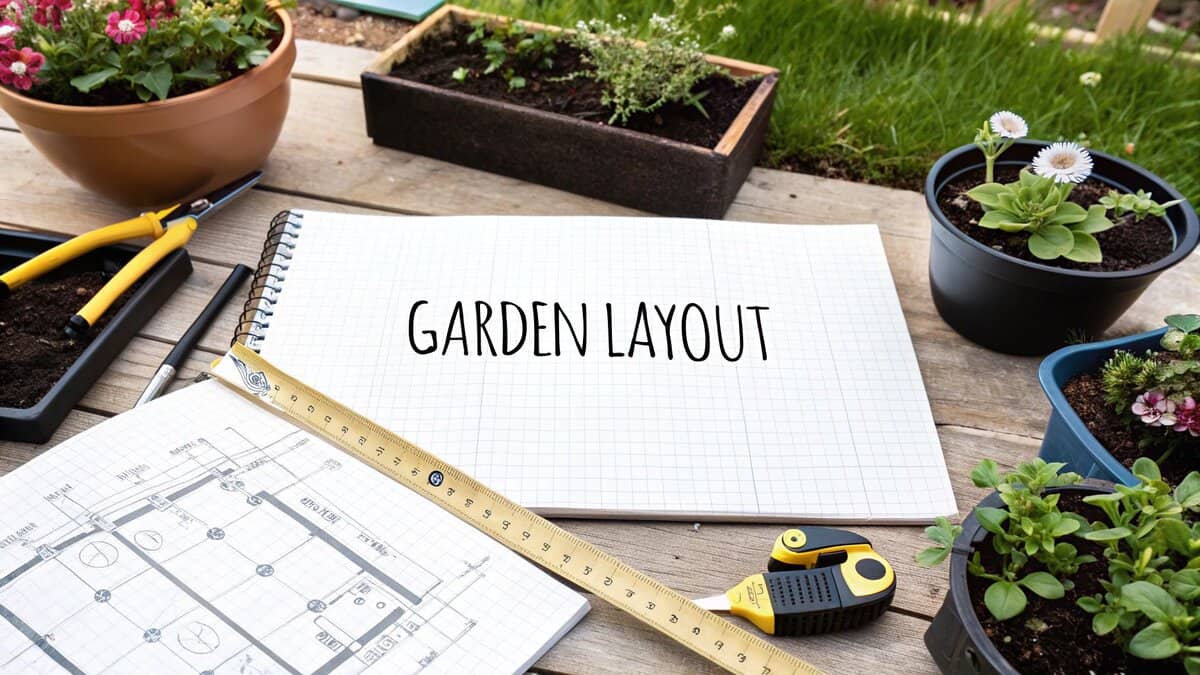
It’s easy to feel overwhelmed when you first think about designing your garden. But trust me, it boils down to three simple, core ideas: assess what you have, define what you want, and sketch out your vision. If you start here, you’ll build a garden that’s not just lovely to look at but genuinely works for you.
For quotes and bookings, call or email us here.
Starting Your Garden Layout Plan Without the Overwhelm
So, you want a new garden. Where on earth do you begin? It’s tempting to jump straight to picking out plants and patio furniture, but a truly great garden plan starts with understanding the canvas you’re working with.
Before you do anything else, get to know your garden’s unique personality. This means watching how the sun moves across the space throughout the day, figuring out which corners stay stubbornly damp, and just generally getting a feel for the existing landscape. For a solid overview, this comprehensive guide to planning a garden is a brilliant starting point.
Here in Stoke-on-Trent and Staffordshire, this initial assessment is absolutely crucial. Our local weather and the common clay soils we deal with bring their own set of challenges—and opportunities. A smart plan takes these local quirks into account from day one, setting your garden up for success.
Your Foundational Steps
The process doesn’t need to be some grand, complicated affair. It’s really just about translating what’s in your head into a workable blueprint on paper.
Start by asking yourself a simple question: what do you actually want from your garden? Is it a safe place for the kids to run wild, a productive veggie patch to feed the family, or a quiet little sanctuary for your morning coffee?
Knowing the answer helps you carve out different zones for different activities. And if the thought of constant upkeep makes you shudder, you’re not alone. Why not have a look at some practical low-maintenance garden ideas? You might find the perfect solution for a beautiful space that doesn’t demand all your weekends.
“Stoke Gardening Services transformed our garden from a space we avoided into our favourite part of the house. They listened to our ideas and created a layout that’s perfect for our family.” – Emma, Burslem
This simple flow chart really captures the heart of the process—turning a fuzzy concept into a concrete plan.

Stick to this Assess, Define, and Sketch approach, and you’ll build a solid foundation. It makes every decision that comes next—from choosing plants to laying paths—so much easier and more effective.
Your Garden Planning Quick-Start Checklist
To help you get started, here’s a quick checklist that breaks down the essential stages of planning your garden layout. Think of it as your roadmap from a blank slate to a beautiful, functional outdoor space.
| Planning Stage | Key Action | Why It Matters for Your Garden |
|---|---|---|
| Assess Your Space | Observe sun paths, check soil type, and note existing features. | Ensures you choose the right plants and materials that will thrive. |
| Define Your Goals | Decide how you’ll use the space: relaxing, playing, entertaining, growing. | Creates a garden that fits your lifestyle, not one you have to fight with. |
| Sketch Your Ideas | Draw a rough layout of zones, paths, and key features. | Helps you visualise the flow and make changes before you start digging. |
| Finalise the Details | Select specific plants, materials for hardscaping, and final features. | Brings your vision to life with the perfect textures, colours, and forms. |
Following these steps in order will keep you focused and prevent that “where do I even start?” feeling, leading you to a garden design you’ll love for years.
Reading the Landscape of Your Stoke-on-Trent Garden

Before you ever draw a line on paper or buy a single plant, the best thing you can do is simply get to know your garden. Every great garden layout starts with a bit of detective work—understanding the unique character of your own outdoor space. This is, without a doubt, the most important step in creating a garden that will flourish right here in Stoke-on-Trent.
Think of it as learning the language of your garden. We always advise clients to spend a full day, from morning to evening, just watching how the light moves. Make a note of which spots get that lovely morning sun, which areas are blasted by the strong afternoon heat, and where the cool, shady corners are. This information is gold. It tells you exactly where to put a bench to catch the last of the evening rays or where your delicate ferns will be happiest.
Understanding Your Soil and Water Flow
Here in Staffordshire, we’re no strangers to heavy clay soil. It’s packed with nutrients, which is great, but it can also get soggy and waterlogged in winter and bake rock-hard in a summer heatwave. Getting a handle on your specific soil type is absolutely essential for a thriving garden.
You can learn a lot with a simple test. Just dig a small hole about a foot deep, fill it with water, and time how long it takes to drain away. If you come back hours later and the water is still sitting there, you’ve got poor drainage to contend with. This is a foundational piece of the puzzle that will influence everything from plant choices to patio construction.
Getting your measurements right is just as crucial. Grab a tape measure and get the basic dimensions down, but don’t stop there. Pinpoint all the existing features you need to work with or around:
- That lovely mature tree you want to keep.
- An old patio or pathway that’s staying put.
- Any manhole covers or utility access points.
- The location of your outdoor tap.
These are the fixed points of your design. For a garden that truly looks its best, sorting out the soil is job number one. Our guide on how to prepare soil for planting has plenty of practical tips for dealing with the classic clay we have in this area.
From Observation to a Workable Plan
Once you’ve gathered all these details—sun patterns, soil type, drainage, and existing features—your vague ideas start to become a solid, workable plan. This isn’t just about doodling on paper; it’s about making smart decisions that will save you a lot of hassle down the line. It’s this in-depth assessment where our experience at Stoke Gardening Services really comes into play.
“I had no idea where to start. Stoke Gardening Services came and assessed our garden, pointing out things about the light and soil I’d never noticed. It made the whole planning process feel logical and achievable.” – David, Hanley
By truly understanding the natural canvas you’re working with, you can create a layout where every element has a purpose and every plant is set up to succeed. This is how you build a garden you’ll love for years to come.
Designing a Garden That Fits Your Lifestyle

A truly great garden is so much more than a collection of pretty plants—it’s an extension of your home, designed around how you actually live. Before you even start thinking about plants, let’s step back and think about what you want to do in your garden. This simple shift in perspective is the secret to creating a space you’ll genuinely love and use for years.
So, what do you picture yourself doing out there? Are you dreaming of hosting big family barbecues on a sunny afternoon? Do you need a safe, open patch of lawn for the kids or the dog to run wild? Or maybe you just want a quiet little corner to sip your morning coffee with a good book.
Each of these dreams points to a different layout need. It’s no surprise that more and more people are investing in their gardens; we all want our own personal outdoor sanctuary. This isn’t just a feeling, either—the market shows people are valuing their garden spaces more than ever.
Creating Functional Garden Zones
Now, let’s take those daydreams and turn them into a practical plan by creating ‘zones’. Think of your garden like a floor plan for your house, with different “rooms” for different activities. You don’t need to build walls, of course. Clever design can create a sense of separation and flow all on its own.
For most UK homes, a few key zones usually come into play:
- The Social Zone: This is your entertaining hub, typically a patio or deck. You’ll want to place it where it gets the best of the afternoon or evening sun and, if possible, make it easy to pop in and out of the kitchen.
- The Play Zone: If you’ve got kids or pets, a simple, open lawn is a must. Just make sure it’s in a spot you can easily see from the house and is clear of any potential hazards.
- The Utility Zone: Every garden needs a practical corner for the shed, compost bins, or the washing line. It’s best to tuck this area away somewhere less noticeable.
- The Quiet Zone: Your personal retreat. This could be as simple as a bench tucked under a tree or a secluded seating area at the far end of the garden—a perfect spot to unwind.
- The Productive Zone: For all you green-fingered growers, this is where your vegetable patch or raised beds will go. It needs plenty of sun and is best located near the kitchen for easy harvesting.
“Stoke Gardening Services helped us think about our garden in a completely new way. We now have a perfect patio for family meals and a safe play area for the kids, all in a space we thought was too small. It’s completely changed how we use our home.” – Sarah, Trentham
Connecting Your Spaces
Once you have a rough idea of your zones, the final piece of the puzzle is making sure they flow together naturally. A winding path can make even a small garden feel like a journey of discovery. You can also use strategic planting—a line of tall grasses or a fragrant lavender hedge, for example—to subtly divide the spaces without closing them off.
If you’re thinking bigger, like integrating a DIY backyard pavilion, make sure it fits both your lifestyle and the garden’s overall feel. Remember, even the most compact Stoke-on-Trent gardens can be cleverly zoned. For more ideas, take a look at our guide on landscaping ideas for small gardens.
By planning these functional areas from the start, your garden stops being just a patch of land and truly becomes part of your home.
Choosing Plants and Materials That Thrive Locally

This is where the fun really begins—picking the plants and materials that bring your garden design to life. It’s the stage where your paper plan starts to feel real, and making the right choices now pays off for years with a healthier, more vibrant garden. For anyone in Stoke-on-Trent, that means choosing plants and building materials that can stand up to our unique local conditions.
The golden rule we always come back to is ‘right plant, right place’. All that groundwork you did during your site assessment, from mapping the sun to testing the soil, is now your most important guide. It’s so tempting to grab whatever looks beautiful at the garden centre, but resist! Stick to your plan and you’ll give every single plant its best shot at success.
Selecting Hardy Plants for Staffordshire Gardens
Here in Staffordshire, we’re often dealing with heavy clay soil and weather that can turn on a sixpence. We need plants that are tough enough to not just survive these conditions but actually thrive in them.
Your best bet is to focus on varieties known for their resilience in the UK. If you have a sunny spot where you’ve managed to improve the clay, perennials like Rudbeckia, Salvia, and hardy Geraniums are fantastic choices for reliable colour. For those shadier spots, you can’t beat the lush foliage of Hostas and Ferns, or the classic beauty of Hydrangeas.
We’ve put together a handy resource covering some of the most reliable and common garden plants that do particularly well around Stoke-on-Trent. It’s a great starting point for your shopping list.
“Stoke Gardening Services didn’t just design our garden; they helped us choose plants that have thrived in our tricky clay soil. Their local knowledge was invaluable.” – Mark, Newcastle-under-Lyme
This approach doesn’t just give you a beautiful garden; it creates one that is more sustainable and requires far less work down the line.
To help you get started, here’s a quick guide to some plants that are well-suited to the typical conditions we see across Stoke and Staffordshire.
Stoke-on-Trent Plant Suitability Guide
| Plant Type | Best For (Sun/Shade) | Soil Preference | Example Species |
|---|---|---|---|
| Hardy Perennials | Full Sun / Partial Shade | Well-drained, improved clay | Geranium ‘Rozanne’, Salvia ‘Caradonna’, Rudbeckia |
| Shade-Lovers | Partial / Full Shade | Moist, humus-rich | Hostas, Ferns (e.g., Dryopteris), Hydrangeas |
| Evergreen Shrubs | Full Sun / Partial Shade | Tolerant of most soils | Skimmia japonica, Viburnum tinus, Choisya ternata |
| Grasses | Full Sun | Well-drained | Stipa tenuissima, Calamagrostis ‘Karl Foerster’ |
Choosing from lists like this takes the guesswork out of planting and sets your garden up for a successful first season.
Choosing Hardscaping Materials for Your Layout
Hardscaping—your paths, patios, walls, and decking—is the skeleton of your garden. The materials you choose will set the tone and style, so it’s vital they complement your home and can handle a British winter (or three).
For a timeless, classic look, you can’t go wrong with natural stone paving like Indian Sandstone or Yorkstone. If your style is more contemporary, sleek porcelain paving or composite decking creates sharp, clean lines for a modern outdoor space.
You also need to think about practicality.
- Paving Slabs: Perfect for patios and primary walkways where you need a solid, durable surface.
- Gravel or Slate Chippings: A brilliant choice for secondary paths or low-traffic zones. Plus, it’s permeable, which helps with drainage.
- Timber or Composite Decking: Great for creating raised seating areas. Just remember that natural timber will need regular looking after.
- Bricks and Sleepers: Ideal for building defined edges or creating stylish raised beds for your veggies or flowers.
Every material has its own character and upkeep needs. Our team at Stoke Gardening Services can guide you through the pros and cons, helping you find materials that not only look fantastic but are the right fit for your garden and your lifestyle.
Time to Make It Real: Bringing Your Garden Plan to Life
You’ve done the hard work of planning. You have sketches, ideas, and a vision for your perfect Stoke-on-Trent garden. Now for the exciting part: turning that dream into a living, breathing space.
While tackling it yourself can be a great experience, bringing in a professional team can take the stress out of the equation and guarantee a polished, lasting result. This is where we love to help.
We’re a local team that helps homeowners across Stoke-on-Trent, Newcastle-under-Lyme, and the surrounding Staffordshire area. We take your plans and passion and add our hands-on expertise to build a garden that truly fits your home and life.
From Paper Plans to a Perfect Patio
Building a garden is so much more than just planting. It’s a full-on construction project that requires a steady hand and an eye for detail. We manage everything, from sourcing the best local materials to building every feature with care.
This means laying patios that are perfectly level, erecting fences that will stand up to the Staffordshire winds, and crafting pathways that invite you to explore.
Often, a great design involves structural work. A well-built retaining wall, for instance, can completely change the layout and usability of a sloped garden. If you’re looking for inspiration, we’ve gathered some of our favourite retaining wall design ideas that work beautifully in local gardens.
Hiring an experienced team isn’t just about getting the heavy lifting done; it’s an investment in getting it right the first time. It’s a growing trend, too. More people are choosing to work with pros, as shown by the global growth in professional gardening services.
“Stoke Gardening Services completely transformed our tired, unused garden into a beautiful space our whole family loves. Their knowledge of what would work in our clay soil was invaluable.” – Sarah, Trentham
The Value of Local Knowledge
Why go with a local team? Simple. We get the unique challenges of gardening in Staffordshire—from our notoriously heavy clay soil to our four-seasons-in-one-day weather.
We know which plants will actually flourish here and which materials can withstand our climate. That inside knowledge saves you time, money, and the heartache of seeing your hard work fail.
Our whole approach is built on collaboration. We start with your ideas and add our practical experience to create a garden that not only looks fantastic when we’re finished but is designed to grow and mature beautifully for years to come. You get to skip the hard work and just watch your new garden take shape.
“From the initial design to the final paving stone, the process was seamless. The team was professional, friendly, and the quality of their work is outstanding.” – Mark, Newcastle-under-Lyme
If you’re ready to see your garden’s potential unlocked, we’d love to have a chat. Let’s talk about how we can bring your vision to life.
Common Garden Layout Planning Questions
As you start pulling all the pieces of your garden plan together, you’re bound to have some questions. It’s completely normal! Here are a few of the most common queries we get from homeowners around Stoke-on-Trent, along with some practical advice to help you move forward with confidence.
How Can I Make My Small Stoke-on-Trent Garden Feel Bigger?
This is the classic small-garden dilemma, but thankfully, it’s one with some really clever solutions. It’s all about tricking the eye and making every square inch work harder.
The best place to start is by thinking vertically. Get some climbing plants like clematis or a lovely rambling rose growing up a trellis or along some wires. This draws the eye upwards, creating a sense of height without eating up precious ground space.
Another great tip is to lay any paving or decking on a diagonal. It’s a simple optical illusion that makes the garden feel much wider than it actually is. You can also paint fences and walls in cool, light colours—think pale blues, soft greys, or off-whites. These shades recede, making the boundaries of your garden feel further away.
Finally, avoid a straight path that leads directly to the back fence. A gentle, winding path that disappears behind a well-placed shrub or a large pot creates a bit of mystery and makes the garden feel like a longer journey to explore.
“I thought my small Tunstall garden was a lost cause. Stoke Gardening Services showed me how to use vertical space and clever planting. It feels twice the size now and is my favourite place to be.” – Janet, Tunstall
Is Drainage a Big Issue in Staffordshire and How Can I Fix It?
In a word, yes. The heavy clay soil common across our region can be a real headache for drainage. When water has nowhere to go, you get waterlogged roots, which can kill off many plants and turn your lawn into a boggy mess.
It’s easy to test your own garden. Just dig a hole about a foot deep, fill it with water, and see how long it takes to drain. If the water is still sitting there after four or five hours, you’ve probably got a drainage issue.
The best long-term fix is to get plenty of organic matter—like your own compost or well-rotted manure—dug into the soil. Over time, this works wonders for the soil structure, creating tiny air pockets that help water drain away more freely.
For areas with really stubborn drainage, building raised beds is a fantastic solution. It physically lifts the main growing area up and away from the soggy ground below, giving your plants’ roots the breathing room they need to thrive.
As you get into the nitty-gritty of your plan, remember that a knowledgeable Stoke-on-Trent gardener can give you an expert opinion and suggest the best drainage solutions for your specific garden.
Our Services
Ready to turn that rough sketch into a beautiful, living garden? The team at Stoke Gardening Services has the local know-how to bring your vision to life, from helping with design ideas to the final build. Get in touch today for a friendly, no-obligation chat about your garden’s potential.
For quotes and bookings, call or email us here.